Description
As is widely known, IAF-AB is conducting various technical courses inviting interested personnel/technocrats for enhancing & fine-tuning of the skill.
IAF-AB organizing Four Days Advance Training Programme Classroom & online Training course for IQIPS-Improving Quality in Physiological services accreditation (IQIPS) series management system.
- ISO INTRODUCTION
The standards published by ISO undergo changes periodically, to reflect the best-suited practices over the changing times. ISO series of standards
For a business unit to successfully set up an IQIPS-Improving Quality in Physiological services accreditation (IQIPS) management systems or get maximum benefits from an established management system, auditors within the organization have to be trained to assess the system IQIPS-Improving Quality in Physiological services accreditation (IQIPS) requirements. They must also be able to assess their suppliers required management system to support own Quality Initiative.
To increase professionalism, quality auditors also seek formal registration with the IAF-AB (UK & INDIA) one of the prerequisites for such registration requires the quality auditors and practitioners to successfully complete an IAF-AB (UK & INDIA) approved auditor training.
- OBJECTIVE OF THE COURSE:
The objective of the course is to illustrate the importance of the Four days Advance Training Programme role, skills and competency in bearing the ultimate responsibility for the effective performance of the audit team. A practical and intensive course for training quality professionals to External, Internal and manage third and second party audits of an IQIPS-Improving Quality in Physiological services accreditation (IQIPS) Management System.
Course describes how to plan and perform an audit, report findings, conduct opening and closing meetings and establish follow-up action. You will understand by the end of the course how regular auditing by an audit team directed by a competent internal auditor is the foundation of an effective IQIPS-Improving Quality in Physiological services accreditation (IQIPS)
Management System. On completion of the course, you will have the necessary skills and the experience to Internal Audit and manage your own audits. The learning process will include a
series of tutorials, exercises, culminating in both practical and written examination. Delegates will be supplied with a bound set of comprehensive course notes.
- COURSE CONTENTS:
- Introduction to IQIPS-Improving Quality in Physiological services accreditation (IQIPS) Management System
- Vocabulary & understanding definitions
- Introduction to IQIPS-Improving Quality in Physiological services accreditation (IQIPS)- Management System Requirements
- Need for Internal Quality Audits
- Auditing Techniques
- Conducting Internal Quality Audits
- Course Examination with minimum 50% passing marks.
Day 1: Introduction to IQIPS and Quality Improvement in Physiological Services
Session 1: Overview of IQIPS
- Understanding IQIPS
- Definition and significance of IQIPS in healthcare.
- Historical context and development of IQIPS standards.
- Key Principles of IQIPS
- The core principles of quality improvement in physiological services.
- Alignment with national and international quality frameworks.
Session 2: The Role of Physiological Services in Healthcare
- Types of Physiological Services
- Overview of various physiological services (e.g., cardiology, respiratory, neurophysiology).
- Importance of these services in patient care and outcomes.
- Stakeholders in Physiological Services
- Identifying key stakeholders and their roles in quality improvement.
Session 3: Understanding Quality Improvement
- Quality Improvement Concepts
- Key concepts and theories of quality improvement in healthcare.
- The importance of a culture of quality in healthcare organizations.
- Models of Quality Improvement
- Overview of quality improvement models (e.g., PDSA, Six Sigma, Lean).
- Selecting the right model for physiological services.
Session 4: Introduction to Accreditation Processes
- Accreditation Basics
- Definition and purpose of accreditation in healthcare.
- Overview of the accreditation process and its significance for physiological services.
- Role of Accreditation Bodies
- Understanding the role of accreditation bodies in setting standards and evaluating compliance.
Group Activity:
- Participants share experiences and challenges in implementing quality improvements in physiological services.
Day 2: IQIPS Standards and Implementation Strategies
Session 5: Detailed Overview of IQIPS Standards
- Structure of IQIPS Standards
- Overview of the IQIPS standards framework.
- Key domains and their significance (e.g., leadership, patient experience, safety).
- Understanding Requirements
- In-depth analysis of requirements for achieving IQIPS accreditation.
- Key performance indicators and measurement criteria.
Session 6: Developing a Quality Management System (QMS)
- Establishing a QMS
- Principles of developing an effective QMS tailored for physiological services.
- Importance of documentation and standard operating procedures (SOPs).
- Integrating IQIPS Standards into QMS
- Strategies for embedding IQIPS standards within existing QMS.
- Tools for monitoring and improving quality.
Session 7: Quality Improvement Initiatives
- Identifying Improvement Areas
- Techniques for identifying areas for improvement in physiological services.
- Conducting gap analysis against IQIPS standards.
- Implementing Quality Improvement Projects
- Steps for planning and executing quality improvement initiatives.
- Engaging staff and stakeholders in the process.
Session 8: Data Collection and Analysis
- Importance of Data in Quality Improvement
- The role of data in driving quality improvements and decision-making.
- Types of data required for IQIPS accreditation.
- Tools for Data Analysis
- Overview of tools and techniques for data collection and analysis (e.g., statistical process control, surveys).
Group Activity:
- Participants work in groups to develop a mini quality improvement project plan based on identified areas for improvement.
Day 3: Assessments, Audits, and Continuous Quality Improvement
Session 9: Preparing for Accreditation Assessments
- Understanding Assessment Processes
- Overview of accreditation assessment processes specific to IQIPS.
- Types of assessments (self-assessments, external assessments, peer reviews).
- Preparing for External Assessments
- Key steps to prepare for successful accreditation assessments.
- Importance of pre-assessment and mock audits.
Session 10: Conducting Internal Audits
- Role of Internal Audits in Quality Management
- Importance of internal audits in maintaining quality standards.
- Planning and executing effective internal audits for physiological services.
- Identifying Non-Conformities
- Techniques for identifying non-conformities and areas of improvement during audits.
- Documenting findings and developing corrective action plans.
Session 11: Continuous Quality Improvement (CQI)
- Principles of Continuous Quality Improvement
- Understanding the CQI cycle and its application in physiological services.
- Importance of ongoing monitoring and evaluation.
- Engaging Staff in CQI
- Strategies for fostering a culture of continuous improvement among staff.
- Encouraging feedback and suggestions for quality enhancement.
Session 12: Handling Complaints and Feedback
- Managing Complaints Effectively
- Importance of having a structured complaint management system.
- Strategies for addressing and resolving complaints.
- Utilizing Feedback for Improvement
- Techniques for gathering and analyzing feedback from patients and stakeholders.
- Implementing changes based on feedback to improve services.
Group Activity:
- Participants engage in role-playing exercises to practice handling complaints and feedback.
Day 4: Future Trends, Challenges, and Course Review
Session 13: Future Trends in Physiological Services
- Emerging Trends in Healthcare Quality
- Overview of emerging trends affecting quality in physiological services (e.g., digital health, telemedicine).
- Impact of technological advancements on quality improvement initiatives.
- Preparing for Future Challenges
- Identifying potential challenges and barriers to achieving IQIPS accreditation.
- Strategies for overcoming these challenges.
Session 14: Case Studies and Best Practices
- Learning from Successful Implementations
- Case studies of healthcare organizations successfully achieving IQIPS accreditation.
- Best practices and lessons learned from these organizations.
- Benchmarking and Collaboration
- The importance of benchmarking against other organizations in quality improvement efforts.
- Collaborating with other departments and services for enhanced quality.
Session 15: Course Review and Key Takeaways
- Recap of Key Concepts and Skills
- Summary of major topics covered throughout the training.
- Participants reflect on their learning and how it applies to their organizations.
- Planning for Implementation
- Developing personal action plans for implementing IQIPS principles in participants’ organizations.
Session 16: Certification of Completion
- Issuing Certificates
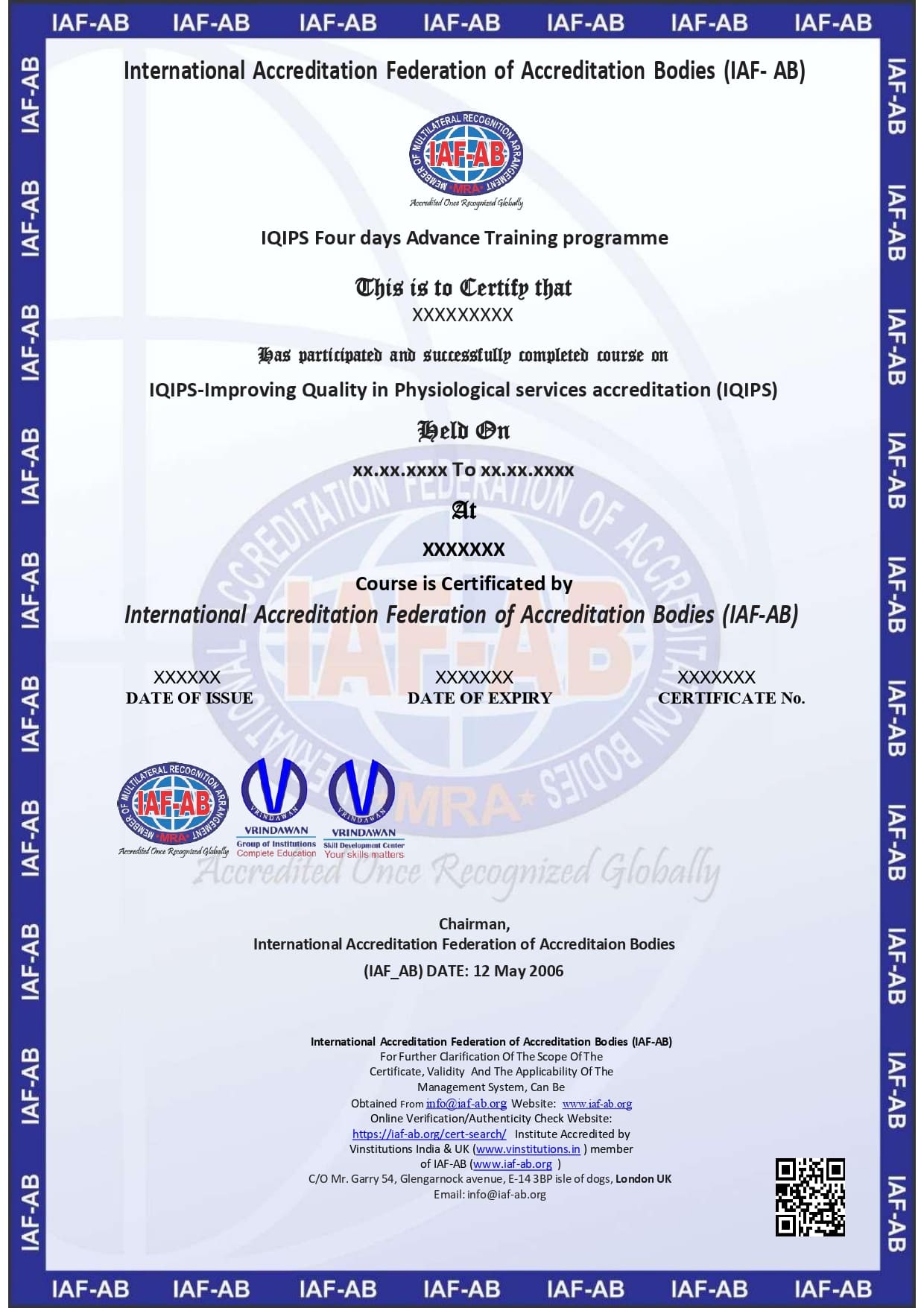
- Participants receive certificates of completion for the training program.
- Networking Opportunities
- Facilitating networking among participants for future collaboration and support.
Learning Outcomes:
By the end of this training, participants will:
- Understand the IQIPS standards and their application in physiological services.
- Develop and implement effective quality management systems in healthcare settings.
- Conduct internal audits and prepare for accreditation assessments.
- Engage stakeholders and foster a culture of continuous quality improvement.
- Identify emerging trends and challenges in quality improvement initiatives.
Delivery Method:
- Classroom Training: Interactive lectures, group discussions, case studies, and hands-on activities.
- Distance Learning: Virtual presentations, downloadable resources, quizzes, and online discussions.
Materials Provided:
- Comprehensive course manual covering IQIPS standards, quality management principles, and best practices.
- Templates for audit checklists, quality improvement plans, and complaint management processes.
- Certificate of completion for participants.
This training program aims to equip participants with advanced knowledge and practical skills necessary for effectively implementing IQIPS standards and enhancing the quality of physiological services in healthcare organizations
For detail of contents refer our website at https://iaf-ab.org/
- WHO SHOULD ATTEND:
1) All employees whose work responsibility directly affects IQIPS-Improving Quality in Physiological services accreditation (IQIPS).
2) Those individuals willing to take up external auditing as a future profession by becoming an independent auditor.
3) Those who intend to enroll themselves to IAF-AB (UK & INDIA) Registration Schemes of IQIPS-Improving Quality in Physiological services accreditation (IQIPS).
4) Management Representatives responsible for effective implementation and execution of IQIPS-Improving Quality in Physiological services accreditation (IQIPS).
- FACILITIES:
All facility for delegates covering lecture hall, tea and lunch will be arranged by Client or if you are attending the course at IAF-AB office. IAF-AB institute will arrange the above facility.
- COURSE DETAILS:
Detail program of every days training course will be sent / given on the first day to the delegates on registration.
- DURATION:
Four days Advance Training program for IQIPS-Improving Quality in Physiological services accreditation (IQIPS) [Timings: 10.00 am to 6.00 pm]
FEES:
- 4 Days Advance Training program of IQIPS-Improving Quality in Physiological services accreditation (IQIPS) is Rs 18000+18%GST
Payment should be made by Cheque / DD in favour of “IAF-AB, Mumbai”


Reviews
There are no reviews yet.